This function evaluates the F cumulative distribution function.
Function Return Value
FDF — Function value, the probability that an F random variable takes a value less than or equal to the input F. (Output)
Required Arguments
F — Argument for which the F cumulative distribution function is to be evaluated. (Input)
DFN — Numerator
degrees of freedom. (Input)
DFN must be
positive.
DFD — Denominator
degrees of freedom. (Input)
DFD must be
positive.
FORTRAN 90 Interface
Generic: FDF (F, DFN, DFD)
Specific: The specific interface names are S_FDF and D_FDF.
FORTRAN 77 Interface
Single: FDF (F, DFN, DFD)
Double: The double precision name is DFDF.
Description
Function FDF evaluates the distribution function of a Snedecor's F random variable with DFN numerator degrees of freedom and DFD denominator degrees of freedom. The function is evaluated by making a transformation to a beta random variable and then using the routine BETDF. If X is an F variate with v1 and v2 degrees of freedom and Y = v1X/(v2 + v1X), then Y is a beta variate with parameters p = v1/2 and q = v2/2. The function FDF also uses a relationship between F random variables that can be expressed as follows.
FDF(X, DFN, DFD) = 1.0 - FDF(1.0/X, DFD, DFN)
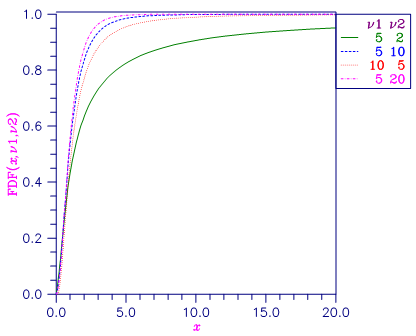
Figure 11- 10 F Distribution Function
Comments
Informational error
Type Code
1 3 Since the input argument F is not positive, the distribution function is zero at F.
Example
In this example, we find the probability that an F random variable with one numerator and one denominator degree of freedom is greater than 648.
USE UMACH_INT
USE FDF_INT
IMPLICIT NONE
INTEGER NOUT
REAL DFD, DFN, F, P
!
CALL UMACH (2, NOUT)
F = 648.0
DFN = 1.0
DFD = 1.0
P = 1.0 - FDF(F,DFN,DFD)
WRITE (NOUT,99999) P
99999 FORMAT (' The probability that an F(1,1) variate is greater ', &
'than 648 is ', F6.4)
END
Output
The probability that an F(1, 1) variate is greater than 648 is 0.0250
|
Visual Numerics, Inc. PHONE: 713.784.3131 FAX:713.781.9260 |