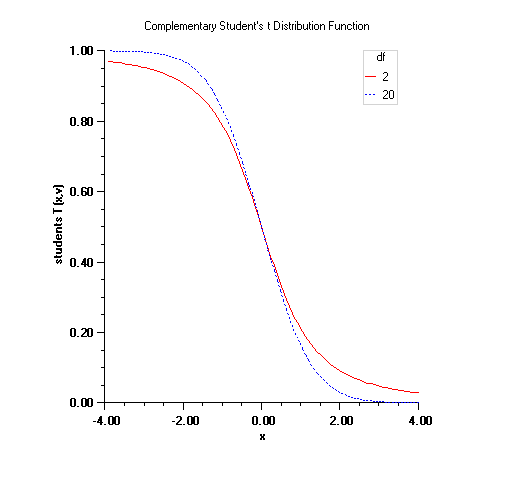
Calculates the complement of the Student's t distribution.
Parameters
- t
- A
doublerepresenting the value for which is to be evaluated.
 - df
- A
doublespecifying the number of degrees of freedom. This must be at least one.
Return Value
A double specifying the probability that a Student's t random variable takes a value greater than t.
Remarks
Method ComplementaryStudentsT evaluates one minus the distribution function of Student's t random variable with df degrees of freedom. If the square of t is greater than or equal to df, the relationship of a t to an f random variable (and subsequently, to a beta random variable) is exploited, and routine Beta is used. Otherwise, the method described by Hill (1970) is used. If df is not an integer, if df is greater than 19, or if df is greater than 200, a Cornish-Fisher expansion is used to evaluate the distribution function. If df is less than 20 and  is less than 2.0, a trigonometric series (see Abramowitz and Stegun 1964, equations 26.7.3 and 26.7.4, with some rearrangement) is used. For the remaining cases, a series given by Hill (1970) that converges well for large values of
 t is used.
This function provides higher right tail accuracy for the Student's t distribution.
See Also
Cdf Class | Imsl.Stat Namespace