.p>.CMCH8.DOC!MIN_UNCON_MULTIVAR;min_uncon_multivar
Minimizes a function f(x) of n variables using a quasi-Newton method.
Synopsis
#include <imsl.h>
float *imsl_f_min_uncon_multivar (float fcn(), int n, ¼, 0)
The type double function is imsl_d_min_uncon_multivar.
Required Arguments
float fcn (int n, float x[])
(Input/Output)
User-supplied function to evaluate the function to be
minimized where n is the size of x, x is the point at
which the function is evaluated, and fcn is the computed
function value at the point x.
int n
(Input)
Number of variables.
Return Value
A pointer to the minimum point x of the function. To release this space, use free. If no solution can be computed, then NULL is returned.
Synopsis with Optional Arguments
#include <imsl.h>
float
*imsl_f_min_uncon_multivar (float
fcn(),
int
n,
IMSL_XGUESS, float
xguess[],
IMSL_GRAD, void
grad(),
IMSL_XSCALE, float
xscale[],
IMSL_FSCALE, float
fscale,
IMSL_GRAD_TOL, float
grad_tol,
IMSL_STEP_TOL, float
step_tol,
IMSL_MAX_STEP, float
max_step,
IMSL_GOOD_DIGIT, int
ndigit,
IMSL_MAX_ITN, int
max_itn,
IMSL_MAX_FCN, int
max_fcn,
IMSL_MAX_GRAD, int
max_grad,
IMSL_INIT_HESSIAN, int
ihess,
IMSL_RETURN_USER, float
x[],
IMSL_FVALUE, float
*fvalue,
IMSL_FCN_W_DATA, float
fcn(),
void *data,
IMSL_GRADIENT_W_DATA, void
grad(),
void *data,
0)
Optional Arguments
IMSL_XGUESS, float xguess[]
(Input)
Array with n components
containing an initial guess of the computed solution.
Default: xguess = 0
IMSL_GRAD, void grad (int n, float x[], float g[])
(Input/Output)
User-supplied function to compute the gradient at the point
x where n is the size of x, x is the point at
which the gradient is evaluated, and g is the computed
gradient at the point x.
IMSL_XSCALE, float xscale[]
(Input)
Array with n components
containing the scaling vector for the variables. xscale is used mainly
in scaling the gradient and the distance between two points. See keywords IMSL_GRAD_TOL and
IMSL_STEP_TOL
for more details.
Default: xscale[] = 1.0
IMSL_FSCALE, float fscale
(Input)
Scalar containing the function scaling. fscale is used mainly
in scaling the gradient. See keyword IMSL_GRAD_TOL for more
details.
Default: fscale = 1.0
IMSL_GRAD_TOL, float grad_tol
(Input)
Scaled gradient tolerance. The i-th component of the scaled
gradient at x is
calculated as

where g = Ñ f(x),
s = xscale, and
fs = fscale.
Default:
 ,
,  in double where ɛ is the machine
precision.
in double where ɛ is the machine
precision.
IMSL_STEP_TOL, float step_tol
(Input)
Scaled step tolerance. The i-th component of the scaled step
between two points x and y is computed as

where s = xscale.
Default:
step_tol = ɛ2/3
IMSL_MAX_STEP, float max_step
(Input)
Maximum allowable step size.
Default: max_step = 1000max (ɛ1, ɛ2) where,

ɛ2 = ||s||2, s = xscale, and t = xguess.
IMSL_GOOD_DIGIT, int ndigit
(Input)
Number of good digits in the function. The default is machine
dependent.
IMSL_MAX_ITN, int max_itn
(Input)
Maximum number of iterations.
Default: max_itn = 100
IMSL_MAX_FCN, int max_fcn
(Input)
Maximum number of function evaluations.
Default: max_fcn = 400
IMSL_MAX_GRAD, int max_grad
(Input)
Maximum number of gradient evaluations.
Default: max_grad = 400
IMSL_INIT_HESSIAN, int ihess
(Input)
Hessian initialization parameter. If ihess is zero, the
Hessian is initialized to the identity matrix; otherwise, it is initialized to a
diagonal matrix containing

on the diagonal where t = xguess, fs = fscale, and
s = xscale.
Default:
ihess = 0
IMSL_RETURN_USER, float x[]
(Output)
User-supplied array with n components
containing the computed solution.
IMSL_FVALUE, float *fvalue
(Output)
Address to store the value of the function at the computed
solution.
IMSL_FCN_W_DATA, float fcn (int n, float x, void *data),
void
*data, (Input)
User supplied function to compute the value of the
function to be minimized, which also accepts a pointer to data that is supplied
by the user. data is a pointer to
the data to be passed to the user-supplied function. See the Introduction, Passing Data to
User-Supplied Functions at the beginning of this manual for more
details.
IMSL_GRADIENT_W_DATA, void grad (int n, float x[], float g[], void *data),
void
*data, (Input)
User supplied function to compute the gradient at the
point x, which
also accepts a pointer to data that is supplied by the user. data is a pointer to
the data to be passed to the user-supplied function. See the Introduction, Passing Data to
User-Supplied Functions at the beginning of this manual for more
details.
Description
The function f_min_uncon_multivar uses a quasi-Newton method to find the minimum of a function f(x) of n variables. The problem is stated as follows:

Given a starting point xc, the search direction is computed according to the formula

where B is a positive definite approximation of the Hessian, and gc is the gradient evaluated at xc. A line search is then used to find a new point
xn = xc + λd, λ > 0
such that
f(xn) ≤ f(xc) + agTd, α Î (0, 0.5)
Finally, the optimality condition ||g(x)|| ≤ ɛ is checked where ɛ is a gradient tolerance.
When optimality is not achieved, B is updated according to the BFGS formula

where s = xn − xc and y = gn − gc. Another search direction is then computed to begin the next iteration. For more details, see Dennis and Schnabel (1983, Appendix A).
In this implementation, the first stopping criterion for imsl_f_min_uncon_multivar occurs when the norm of the gradient is less than the given gradient tolerance grad_tol. The second stopping criterion for imsl_f_min_uncon_multivar occurs when the scaled distance between the last two steps is less than the step tolerance step_tol.
Since by default, a finite-difference method is used to estimate the gradient for some single precision calculations, an inaccurate estimate of the gradient may cause the algorithm to terminate at a noncritical point. In such cases, high precision arithmetic is recommended; the keyword IMSL_GRAD should be used to provide more accurate gradient evaluation.
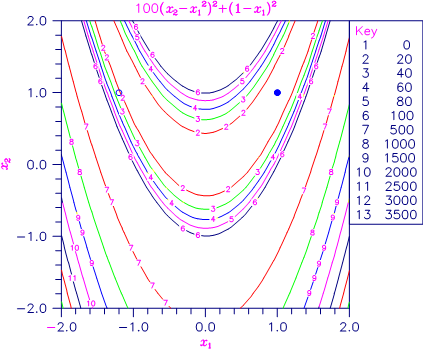
Figure 8- 1 Plot of the Rosenbrock Function
Examples
Example 1
The function

is minimized. In the following plot, the solid circle marks the minimum.
#include <stdio.h>
#include
<imsl.h>
void
main()
{
int i,
n=2;
float *result,
fx;
static float
rosbrk(int,
float[]);
/* Minimize Rosenbrock function
*/
result =
imsl_f_min_uncon_multivar(rosbrk, n,
0);
fx = rosbrk(n,
result);
/* Print results */
printf(" The solution is
");
for (i = 0; i < n; i++)
printf("%8.3f", result[i]);
printf("\n\n The function value is %8.3f\n",
fx);
}
/* end of main */
static float rosbrk(int n, float
x[])
{
float f1,
f2;
f1 = x[1] -
x[0]*x[0];
f2 = 1.0 -
x[0];
return 100.0 * f1 * f1 +
f2 *
f2;
}
/* end of function */
Output
The solution
is 1.000
1.000
The function value is 0.000
Example 2
The function
is minimized with the initial guess x = (−1.2, 1.0). The initial guess is marked with an open circle in the figure on page 15.
#include <stdio.h>
#include
<imsl.h>
void
main()
{
int i,
n=2;
float *result,
fx;
static float
rosbrk(int, float[]);
static
void rosgrd(int, float[],
float[]);
static
float xguess[2] = {-1.2e0, 1.0e0};
static float
grad_tol = .0001;
/* Minimize Rosenbrock function using initial guesses
of -1.2 and 1.0 */
result =
imsl_f_min_uncon_multivar(rosbrk, n, IMSL_XGUESS,
xguess,
IMSL_GRAD,
rosgrd,
IMSL_GRAD_TOL, grad_tol,
IMSL_FVALUE, &fx, 0);
/* Print results
*/
printf(" The solution
is
");
for (i = 0; i < n; i++)
printf("%8.3f", result[i]);
printf("\n\n The function value is %8.3f\n",
fx);
}
/* End of main */
static float rosbrk(int n, float
x[])
{
float f1,
f2;
f1 = x[1] -
x[0]*x[0];
f2 = 1.0e0 -
x[0];
return 100.0 * f1 * f1 +
f2 *
f2;
}
/* End of function */
static void rosgrd(int n, float x[], float
g[])
{
g[0] =
-400.0*(x[1]-x[0]*x[0])*x[0] -
2.0*(1.0-x[0]);
g[1] =
200.0*(x[1]-x[0]*x[0]);
}
/* End of function */
Output
The solution is
1.000 1.000
The function value
is 0.000
Informational Errors
IMSL_STEP_TOLERANCE Scaled step tolerance satisfied. The current point may be an approximate local solution, but it is also possible that the algorithm is making very slow progress and is not near a solution, or that step_tol is too big.
Warning Errors
IMSL_TOO_MANY_ITN Maximum number of iterations exceeded.
IMSL_TOO_MANY_FCN_EVAL Maximum number of function evaluations exceeded.
IMSL_TOO_MANY_GRAD_EVAL Maximum number of gradient evaluations exceeded.
IMSL_UNBOUNDED Five consecutive steps have been taken with the maximum step length.
IMSL_NO_FURTHER_PROGRESS The last global step failed to locate a lower point than the current x value.
Fatal Errors
IMSL_FALSE_CONVERGENCE False convergence—The iterates appear to be converging to a noncritical point. Possibly incorrect gradient information is used, or the function is discontinuous, or the other stopping tolerances are too tight.
|
Visual Numerics, Inc. PHONE: 713.784.3131 FAX:713.781.9260 |