.p>.CMCH3.DOC!SPLINE_LEAST_SQUARES;spline_least_squares
Computes a least-squares spline approximation.
Synopsis
#include <imsl.h>
Imsl_f_spline *imsl_f_spline_least_squares (int ndata, float xdata[], float fdata[], int spline_space_dim, ¼, 0)
The type Imsl_d_spline function is imsl_d_spline_least_squares.
Required Arguments
int ndata
(Input)
Number of data points.
float xdata[]
(Input)
Array with ndata components
containing the abscissas of the least-squares problem.
float fdata[]
(Input)
Array with ndata components
containing the ordinates of the least-squares problem.
int
spline_space_dim (Input)
The linear dimension of the
spline subspace. It should be smaller than ndata and greater than
or equal to order (whose default
value is 4).
Return Value
A pointer to the structure that represents the spline fit. If a fit cannot be computed, then NULL is returned. To release this space, use free.
Synopsis with Optional Arguments
#include <imsl.h>
Imsl_f_spline
*imsl_f_spline_least_squares (int
ndata,
float xdata[], float
fdata[],
int spline_space_dim,
IMSL_SSE, float
*sse_err,
IMSL_WEIGHTS, float
weights[],
IMSL_ORDER, int
order,
IMSL_KNOTS, float
knots[],
IMSL_OPTIMIZE,
0)
Optional Arguments
IMSL_SSE, float *sse
(Output)
This option places the weighted error sum of squares in the place
pointed to by sse.
IMSL_WEIGHTS, float weights[]
(Input)
This option requires the user to provide the weights.
Default: all
weights equal one.
IMSL_ORDER, int order
(Input)
The order of the spline subspace for which the knots are desired.
This option is used to communicate the order of the spline subspace.
Default:
order = 4,
(i.e., cubic splines).
IMSL_KNOTS, float knots[]
(Input)
This option requires the user to provide the knots. The user must
provide a knot sequence of length spline_space_dimension + order.
Default: an
appropriate knot sequence is selected. See below for more details.
IMSL_OPTIMIZE
This
option optimizes the knot locations, by attempting to minimize the least-squares
error as a function of the knots. The optimal knots are available in the
returned spline structure.
Description
Let’s make the identifications
n = ndata
x = xdata
f = fdata
m = spline_space_dim
k = order
For convenience, we assume that the sequence x is increasing, although the function does not require this.
By default, k = 4, and the knot sequence we select equally distributes the knots through the distinct xi’s. In particular, the m + k knots will be generated in [x1, xn] with k knots stacked at each of the extreme values. The interior knots will be equally spaced in the interval.
Once knots t and weights w are determined (and assuming that the option IMSL_OPTIMIZE is not chosen), then the function computes the spline least-squares fit to the data by minimizing over the linear coefficients aj

where the Bj, j = 1, ¼, m are a (B-spline) basis for the spline subspace.
The optional argument IMSL_ORDER allows the user to choose the order of the spline fit. The optional argument IMSL_KNOTS allows user specification of knots. The function imsl_f_spline_least_squares is based on the routine L2APPR by de Boor (1978, p. 255).
If the option IMSL_OPTIMIZE is chosen, then the procedure attempts to find the best placement of knots that will minimize the least-squares error to the given data by a spline of order k with m coefficients. For this problem to make sense, it is necessary that m > k. We then attempt to find the minimum of the functional

The technique employed here uses the fact that for a fixed knot sequence t the minimization in a is a linear least-squares problem that can be easily solved. Thus, we can think of our objective function F as a function of just t by setting

A Gauss-Seidel (cyclic coordinate) method is then used to reduce the value of the new objective function G. In addition to this local method, there is a global heuristic built into the algorithm that will be useful if the data arise from a smooth function. This heuristic is based on the routine NEWNOT of de Boor (1978, pp. 184 and 258−261).
The initial guess, tg, for the knot sequence is either provided by the user or is the default. This guess must be a valid knot sequence for splines of order k with

with tg nondecreasing, and

In regard to execution speed, this function can be several orders of magnitude slower than a simple least-squares fit.
The return value for this function is a pointer of type Imsl_f_spline. The calling program must receive this in a pointer Imsl_f_spline *sp. This structure contains all the information to determine the spline (stored in B-spline form) that is computed by this function. For example, the following code sequence evaluates this spline a x and returns the value in y.
y = imsl_f_spline_value (x, sp, 0);
In the figure below two cubic splines are fit to

Both splines are cubics with the same spline_space_dim = 8. The first spline is computed with the default settings, while the second spline is computed by optimizing the knot locations using the keyword IMSL_OPTIMIZE.
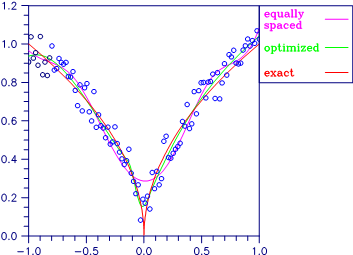
Figure 3- 4 Two Fits
to Noisy
Examples
Example 1
This example fits data generated from a trigonometric polynomial
1 + sinx + 7 sin3x + e
where ɛ is a random uniform deviate over the range [-1, 1]. The data are obtained by evaluating this function at 90 equally spaced points on the interval [0, 6]. This data is fitted with a cubic spline with 12 degrees of freedom (eight equally spaced interior knots). The error at 10 equally spaced points is printed out.
#include <imsl.h>
#include
<stdio.h>
#include <math.h>
#define NDATA
90
/* Define function */
#define F(x) (float)(1.+
sin(x)+7.*sin(3.0*x))
main()
{
int
i, spline_space_dim = 12;
float
fdata[NDATA], xdata[NDATA], *random;
Imsl_f_spline
*sp;
/* Generate random numbers */
imsl_random_seed_set(123457);
random =
imsl_f_random_uniform(NDATA,
0);
/* Set up data */
for (i = 0; i < NDATA;
i++) {
xdata[i] = 6.*(float)i
/((float)(NDATA-1));
fdata[i] =
F(xdata[i]) + 2.*(random[i]-.5);
}
sp = imsl_f_spline_least_squares(NDATA, xdata, fdata,
spline_space_dim, 0);
printf("
x error
\n");
for(i = 0; i < 10; i++)
{
float x,
error;
x =
6.*i/9.;
error = F(x) -
imsl_f_spline_value(x, sp, 0);
printf("%10.3f %10.3f\n", x, error);
}
}
Output
x
Error
0.000
-0.356
0.667
-0.004
1.333
0.434
2.000
-0.069
2.667
-0.494
3.333
0.362
4.000
-0.273
4.667
-0.247
5.333
0.303
6.000 0.578
Example 2
This example continues with the first example in which we fit data generated from the trigonometric polynomial
1 + sinx + 7 sin3x + e
where ɛ is random uniform deviate over the range [−1, 1]. The data is obtained by evaluating this function at 90 equally spaced points on the interval [0, 6]. This data was fitted with a cubic spline with 12 degrees of freedom (in this case, the default gives us eight equally spaced interior knots) and the error sum of squares was printed. In this example, the knot locations are optimized and the error sum of squares is printed. Then, the error at 10 equally spaced points is printed.
#include <imsl.h>
#include
<stdio.h>
#include <math.h>
#define NDATA
90
/* Define function */
#define F(x)
(float)(1.+ sin(x)+7.*sin(3.0*x))
main()
{
int
i, spline_space_dim = 12;
float
fdata[NDATA], xdata[NDATA], *random, sse1, sse2;
Imsl_f_spline
*sp;
/* Generate random numbers */
imsl_random_seed_set(123457);
random =
imsl_f_random_uniform(NDATA, 0);
/* Set up data */
for (i = 0; i < NDATA; i++)
{
xdata[i] = 6.*(float)i
/((float)(NDATA-1));
fdata[i] =
F(xdata[i]) + 2.*(random[i]-.5);
}
sp = imsl_f_spline_least_squares(NDATA, xdata, fdata,
spline_space_dim,
IMSL_SSE,
&sse1,
0);
sp = imsl_f_spline_least_squares(NDATA, xdata, fdata,
spline_space_dim,
IMSL_OPTIMIZE,
IMSL_SSE,
&sse2,
0);
printf("The error sum of squares before optimizing is
%10.1f\n",
sse1);
printf("The error sum of squares after optimizing is %10.1f\n\n",
sse2);
printf("
x
error\n");
for(i = 0; i < 10;
i++){
float x,
error;
x =
6.*i/9.;
error = F(x) -
imsl_f_spline_value(x, sp, 0);
printf("%10.3f %10.3f\n", x, error);
}
}
Output
The error sum of squares before optimizing
is 32.6
The error sum of squares
after optimizing is
27.0
x
Error
0.000
-0.656
0.667
0.107
1.333
0.055
2.000
-0.243
2.667
-0.063
3.333
-0.015
4.000
-0.424
4.667
-0.138
5.333
0.133
6.000
0.494
Warning Errors
IMSL_OPT_KNOTS_STACKED_1 The knots found to be optimal are stacked more than order. This indicates fewer knots will produce the same error sum of squares. The knots have been separated slightly.
Fatal Errors
IMSL_XDATA_TOO_LARGE The array xdata must satisfy xdatai ≤ tndata, for i = 1, ¼, ndata.
IMSL_XDATA_TOO_SMALL
The array xdata
must satisfy
xdatai ³ torder-1, for i = 1, ¼, ndata.
IMSL_NEGATIVE_WEIGHTS All weights must be greater than or equal to zero.
IMSL_KNOT_MULTIPLICITY Multiplicity of the knots cannot exceed the order of the spline.
IMSL_KNOT_NOT_INCREASING The knots must be nondecreasing.
IMSL_OPT_KNOTS_STACKED_2 The knots found to be optimal are stacked more than order. This indicates fewer knots will produce the same error sum of squares.
|
Visual Numerics, Inc. PHONE: 713.784.3131 FAX:713.781.9260 |