- java.lang.Object
-
- com.imsl.math.NonlinLeastSquares
-
- All Implemented Interfaces:
- Serializable, Cloneable
public class NonlinLeastSquares
extends Object
implements Serializable, Cloneable
Nonlinear least squares.NonlinLeastSquaresis based on the MINPACK routineLMDIFby Moré et al. (1980). It uses a modified Levenberg-Marquardt method to solve nonlinear least squares problems. The problem is stated as follows:
where
 ,
,  ,
and
,
and  is the i-th component function of
F(x). From a current point, the algorithm uses the trust
region approach:
is the i-th component function of
F(x). From a current point, the algorithm uses the trust
region approach:
subject to

to get a new point
 , which is computed as
where
 if
if  and
and
 otherwise.
  and
and
 are the function values and the Jacobian
evaluated at the current point
are the function values and the Jacobian
evaluated at the current point  . This procedure is
repeated until the stopping criteria are satisfied. The first stopping
criteria occurs when the norm of the function is less than the value set in
method
. This procedure is
repeated until the stopping criteria are satisfied. The first stopping
criteria occurs when the norm of the function is less than the value set in
method setAbsoluteTolerance. The second stopping criteria occurs when the norm of the scaled gradient is less than the value set in methodsetGradientTolerance. The third stopping criteria occurs when the scaled distance between the last two steps is less than the value set by methodsetStepTolerance. For more details, see Levenberg (1944), Marquardt (1963), or Dennis and Schnabel (1983, Chapter 10).A finite-difference method is used to estimate the Jacobian when the user supplied function,
f, defines the least-squares problem. Whenever the exact Jacobian can be easily provided,fshould implementNonlinLeastSquares.Jacobian.
-
-
Nested Class Summary
Nested Classes Modifier and Type Class and Description static interfaceNonlinLeastSquares.FunctionPublic interface for the user supplied function to theNonlinLeastSquaresobject.static interfaceNonlinLeastSquares.JacobianPublic interface for the user supplied function to theNonlinLeastSquaresobject.static classNonlinLeastSquares.TooManyIterationsExceptionToo many iterations.
-
Constructor Summary
Constructors Constructor and Description NonlinLeastSquares(int m, int n)Creates an object to solve a nonlinear least squares problem.
-
Method Summary
Methods Modifier and Type Method and Description intgetErrorStatus()Get information about the performance of NonlinLeastSquares.intgetNumberOfThreads()Returns the number ofjava.lang.Threadinstances used for parallel processing.voidsetAbsoluteTolerance(double absoluteTolerance)Set the absolute function tolerance.voidsetDigits(int ngood)Set the number of good digits in the function.voidsetFalseConvergenceTolerance(double falseConvergenceTolerance)Set the false convergence tolerance.voidsetFscale(double[] fscale)Set the diagonal scaling matrix for the functions.voidsetGradientTolerance(double gradientTolerance)Set the scaled gradient tolerance stopping critierion.voidsetGuess(double[] xguess)Set the initial guess of the minimum point of the input function.voidsetInitialTrustRegion(double initialTrustRegion)Set the initial trust region radius.voidsetMaximumStepsize(double maximumStepsize)Set the maximum allowable stepsize to use.voidsetMaxIterations(int maxIterations)Set the maximum number of iterations allowed.voidsetNumberOfThreads(int numberOfThreads)Sets the number ofjava.lang.Threadinstances to be used for parallel processing.voidsetRelativeTolerance(double relativeTolerance)Set the relative function tolerance.voidsetStepTolerance(double stepTolerance)Set the scaled step tolerance.voidsetXscale(double[] xscale)Set the diagonal scaling matrix for the variables.double[]solve(NonlinLeastSquares.Function F)Solve a nonlinear least-squares problem using a modified Levenberg-Marquardt algorithm and a Jacobian.
-
-
-
Constructor Detail
-
NonlinLeastSquares
public NonlinLeastSquares(int m,
                  int n)
Creates an object to solve a nonlinear least squares problem.- Parameters:
m- is the number of functionsn- is the number of variables. n must be less than or equal to m.
-
-
Method Detail
-
getErrorStatus
public int getErrorStatus()
Get information about the performance of NonlinLeastSquares.- Returns:
- an
intspecifying information about convergence.VALUE DESCRIPTION 0 All convergence tests were met. 1 Scaled step tolerance was satisfied. The current point may be an approximate local solution, or the algorithm is making very slow progress and is not near a solution, or StepTolerance is too big. 2 Scaled actual and predicted reductions in the function are less than or equal to the relative function convergence tolerance RelativeTolerance. 3 Iterates appear to be converging to a noncritical point. Incorrect gradient information, a discontinuous function, or stopping tolerances being too tight may be the cause. 4 Five consecutive steps with the maximum stepsize have been taken. Either the function is unbounded below, or has a finite asymptote in some direction, or the maximum stepsize is too small. - See Also:
setRelativeTolerance(double),setStepTolerance(double)
-
getNumberOfThreads
public int getNumberOfThreads()
Returns the number ofjava.lang.Threadinstances used for parallel processing.- Returns:
- an
intcontaining the number ofjava.lang.Threadinstances used for parallel processing.
-
setAbsoluteTolerance
public void setAbsoluteTolerance(double absoluteTolerance)
Set the absolute function tolerance.- Parameters:
absoluteTolerance- adoublescalar value specifying the absolute function tolerance. When the norm of the function is less thanabsoluteTolerancethe procedure stops.Default:
absoluteTolerance= 1.0e-32- Throws:
IllegalArgumentException- is thrown ifabsoluteToleranceis less than or equal to 0
-
setDigits
public void setDigits(int ngood)
Set the number of good digits in the function. If this member function is not called, the number of good digits is set to 7.- Parameters:
ngood- anintspecifying the number of good digits in the user supplied function which defines the least-squares problem- Throws:
IllegalArgumentException- is thrown if ngood is less than or equal to 0
-
setFalseConvergenceTolerance
public void setFalseConvergenceTolerance(double falseConvergenceTolerance)
Set the false convergence tolerance. If this member function is not called, 100.0e-16 is used as the false convergence tolerance.- Parameters:
falseConvergenceTolerance- a double scalar value specifying the false convergence tolerance- Throws:
IllegalArgumentException- is thrown if falseConvergenceTolerance is less than or equal to 0
-
setFscale
public void setFscale(double[] fscale)
Set the diagonal scaling matrix for the functions.- Parameters:
fscale- adoublearray specifying the diagonal scaling matrix for the functions. The i-th component offscaleis a positive scalar specifying the reciprocal magnitude of the i-th component function of the problem. By default, the identity is used.- Throws:
IllegalArgumentException- is thrown if any of the elements of fscale is less than or equal to 0
-
setGradientTolerance
public void setGradientTolerance(double gradientTolerance)
Set the scaled gradient tolerance stopping critierion.- Parameters:
gradientTolerance- adoublespecifying the scaled gradient tolerance used in stopping criteria. The i-th component of the scaled gradient atxis calculated as
where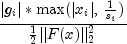
J(x) is the Jacobian, s =
xscale, =
= fscale, and
When the norm of the scaled gradient is less than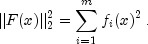
gradientTolerancethe procedure stops.By default,
gradientTolerance=![sqrt[3]{varepsilon }](eqn_1074.png) where
where  is machine precision.
- Throws:
IllegalArgumentException- is thrown if gradientTolerance is less than or equal to 0
-
setGuess
public void setGuess(double[] xguess)
Set the initial guess of the minimum point of the input function. If this member function is not called, an initial guess of 0.0 is used.- Parameters:
xguess- adoublearray specifying the initial guess of the minimum point of the input function
-
setInitialTrustRegion
public void setInitialTrustRegion(double initialTrustRegion)
Set the initial trust region radius. If this member function is not called, a default is set based on the initial scaled Cauchy step.- Parameters:
initialTrustRegion- adoublescalar value specifying the initial trust region radius- Throws:
IllegalArgumentException- is thrown if initialTrustRegion is less than or equal to 0
-
setMaximumStepsize
public void setMaximumStepsize(double maximumStepsize)
Set the maximum allowable stepsize to use. If this member function is not called, maximum stepsize is set to a default value based on a scaled xguess.- Parameters:
maximumStepsize- a nonnegativedoublevalue specifying the maximum allowable stepsize.- Throws:
IllegalArgumentException- is thrown if maximumStepsize is less than or equal to 0
-
setMaxIterations
public void setMaxIterations(int maxIterations)
Set the maximum number of iterations allowed. If this member function is not called, the maximum number of iterations is set to 100.- Parameters:
maxIterations- anintspecifying the maximum number of iterations allowed- Throws:
IllegalArgumentException- is thrown if maxIterations is less than or equal to 0
-
setNumberOfThreads
public void setNumberOfThreads(int numberOfThreads)
Sets the number ofjava.lang.Threadinstances to be used for parallel processing.- Parameters:
numberOfThreads- anintspecifying the number ofjava.lang.Threadinstances to be used for parallel processing. IfnumberOfThreadsis greater than 1, then interfaceFunction.fis evaluated in parallel andFunction.fmust be thread-safe. Otherwise, unexpected behavior can occur.Default:
numberOfThreads= 1.
-
setRelativeTolerance
public void setRelativeTolerance(double relativeTolerance)
Set the relative function tolerance.- Parameters:
relativeTolerance- adoublescalar value specifying the relative function toleranceDefault:
relativeTolerance= 1.0e-20- Throws:
IllegalArgumentException- is thrown ifrelativeToleranceis less than or equal to 0
-
setStepTolerance
public void setStepTolerance(double stepTolerance)
Set the scaled step tolerance.- Parameters:
stepTolerance- adoublescalar value specifying the scaled step tolerance used in stopping criteria. The i-th component of the scaled step between two points x and y is computed as
where s =
xscale. When the scaled distance between the last two steps is less thanstepTolerancethe procedure stops.By default,
stepTolerance=![sqrt[3]{varepsilon }](eqn_1077.png) where
where  is machine precision.
- Throws:
IllegalArgumentException- is thrown if stepTolerance is less than or equal to 0
-
setXscale
public void setXscale(double[] xscale)
Set the diagonal scaling matrix for the variables.- Parameters:
xscale- adoublearray specifying the diagonal scaling matrix for the variables.xscaleis used in scaling the gradient and the distance between two points. See methodssetGradientToleranceandsetStepTolerancefor more detail. By default, the identity is used.- Throws:
IllegalArgumentException- is thrown if any of the elements of xscale is less than or equal to 0
-
solve
public double[] solve(NonlinLeastSquares.Function F)
               throws NonlinLeastSquares.TooManyIterationsException
Solve a nonlinear least-squares problem using a modified Levenberg-Marquardt algorithm and a Jacobian.- Parameters:
F- User supplied function that defines the least-squares problem. If F implements Jacobian then its Jacobian is used. Otherwise, a finite difference Jacobian is used.- Returns:
- a
doublearray of length n containing the approximate solution - Throws:
NonlinLeastSquares.TooManyIterationsException- is thrown if the number of iterations exceeds MaxIterations. MaxIterations is set to 100 by default.
-
-