

| SVD Class |
 Inheritance Hierarchy
Namespace: Imsl.Math
Assembly: ImslCS (in ImslCS.dll) Version: 6.5.2.0
SyntaxThe SVD type exposes the following members.
Constructors| Name | Description | |
|---|---|---|
 | SVD(Double) |
Construct the singular value decomposition of a rectangular matrix
with default tolerance.
|
| SVD(Double, Double) |
Construct the singular value decomposition of a rectangular matrix
with a given tolerance.
|
Methods| Name | Description | |
|---|---|---|
| Equals | Determines whether the specified object is equal to the current object. (Inherited from Object.) |
 | Finalize | Allows an object to try to free resources and perform other cleanup operations before it is reclaimed by garbage collection. (Inherited from Object.) |
| GetHashCode | Serves as a hash function for a particular type. (Inherited from Object.) |
| GetS |
Returns the singular values.
|
| GetType | Gets the Type of the current instance. (Inherited from Object.) |
| GetU |
Returns the left singular vectors.
|
| GetV |
Returns the right singular vectors.
|
| Inverse |
Compute the Moore-Penrose generalized inverse of a real matrix.
|
| MemberwiseClone | Creates a shallow copy of the current Object. (Inherited from Object.) |
| ToString | Returns a string that represents the current object. (Inherited from Object.) |
Properties| Name | Description | |
|---|---|---|
 | Info |
Returns the index of the first singular value for which the algorithm
converged.
|
| NumberOfProcessors |
Perform the parallel calculations with the maximum possible number of
processors set to NumberOfProcessors.
|
| Rank |
Returns the rank of the matrix used to construct this instance.
|
RemarksSVD is based on the LINPACK routine SSVDC; see Dongarra et al. (1979).
Let n be the number of rows in A and let p be the number of columns in A. For any
n x p matrix A, there exists an n x n orthogonal matrix U and a p x p orthogonal matrix V such that
![U^T A V = \left\{ \begin{array}{cl} \left[
\begin{array}{l} \Sigma \\ 0 \end{array} \right] & \mbox{if $n \ge
p$} \\ \left[ \Sigma \,\, 0 \right] & \mbox{if $n \le p$}
\end{array} \right.](eqn/eqn_1884.png)
where  , and
, and  . The scalars
 are called the singular values of A. The
columns of U are called the left singular vectors of
A. The columns of V are called the
right singular vectors of A.
are called the singular values of A. The
columns of U are called the left singular vectors of
A. The columns of V are called the
right singular vectors of A.
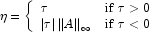
The estimated rank of A is the number of  that is larger than a tolerance
  .
If
.
If  is the parameter tol in the program,
then
is the parameter tol in the program,
then
The Moore-Penrose generalized inverse of the matrix is computed by
partitioning the matrices U, V and
 as
as  ,
,
 and
and
 where the "1" matrices are k by k. The Moore-Penrose
generalized inverse is
where the "1" matrices are k by k. The Moore-Penrose
generalized inverse is  .
.
See Also