The section describes an algorithm and a corresponding integrator routine imsl_f_pde_1d_mg for solving a system of partial differential equations

Equation 1
This software is a one-dimensional
differential equation solver. It requires the user to provide initial and
boundary conditions in addition to a function for the evaluation of . The integration method is
noteworthy due to the maintenance of grid lines in the space variable,
. The integration method is
noteworthy due to the maintenance of grid lines in the space variable,  . Details for choosing new
grid lines are given in Blom and Zegeling, (1994). The class of problems
solved with imsl_f_pde_1d_mg is expressed by Equation
1 and
given in more detail by:
. Details for choosing new
grid lines are given in Blom and Zegeling, (1994). The class of problems
solved with imsl_f_pde_1d_mg is expressed by Equation
1 and
given in more detail by:

Equation 2
The vector  is the solution. The integer value
  is the number of
differential equations. The functions
is the number of
differential equations. The functions  and
and  can be regarded, in special cases,
as flux and source terms. The functions
can be regarded, in special cases,
as flux and source terms. The functions  are expected to be
continuous. Allowed values for the integer
are expected to be
continuous. Allowed values for the integer  are any of
 . These are respectively for
problems in Cartesian, cylindrical or polar, and spherical coordinates. In
the two cases with
. These are respectively for
problems in Cartesian, cylindrical or polar, and spherical coordinates. In
the two cases with , the
interval
, the
interval  must not
contain
must not
contain  as an
interior point.
as an
interior point.
The boundary conditions have the master equation form

In the boundary conditions the functions and
and  are continuous. In the two
cases with , with an
endpoint of at 0,
the finite value of the solution at must be ensured. This requires the specification of
the solution at, or it
implies that
are continuous. In the two
cases with , with an
endpoint of at 0,
the finite value of the solution at must be ensured. This requires the specification of
the solution at, or it
implies that  or
or
 . The initial
values satisfy
. The initial
values satisfy ,
where
,
where is a piece-wise
continuous vector function of with
is a piece-wise
continuous vector function of with  components.
The user must pose the problem so that mathematical definitions are known for the functions

These functions are provided to the routine imsl_f_pde_1d_mg in the form of two user-supplied
functions. This form of the usage interface is explained below and
illustrated with several examples. can be supplied as the input argument u
or by an optional user-supplied function. Users comfortable with the description
of this algorithm may skip directly to the Examples section.
Description Summary
Equation 1 is approximated at  time-dependent grid
values
time-dependent grid
values . Using the
total differential
. Using the
total differential  transforms the differential equation to the form

Using central divided differences for the factor  leads to the system of ordinary
differential equations in implicit form
leads to the system of ordinary
differential equations in implicit form

The terms  respectively represent the approximate solution to the
partial differential equation and the value of
respectively represent the approximate solution to the
partial differential equation and the value of  at the point
 . The truncation error from
this approximation is second-order in the space variable. The above ordinary
differential equations are underdetermined, so additional equations are added
for determining the time-dependent grid points. These additional equations
contain parameters that can be adjusted by the user. Often it will be
necessary to modify these parameters to solve a difficult problem. For
this purpose the following quantities are needed:
. The truncation error from
this approximation is second-order in the space variable. The above ordinary
differential equations are underdetermined, so additional equations are added
for determining the time-dependent grid points. These additional equations
contain parameters that can be adjusted by the user. Often it will be
necessary to modify these parameters to solve a difficult problem. For
this purpose the following quantities are needed:

The values are the so-called point concentration of the grid. The
parameter
are the so-called point concentration of the grid. The
parameter denotes a
spatial smoothing value. Now the grid points are defined implicitly so
that
denotes a
spatial smoothing value. Now the grid points are defined implicitly so
that

The parameter  denotes a time-smoothing value. If
the value
denotes a time-smoothing value. If
the value is chosen to be
large, this results in a fixed spatial grid. Increasing from its default value avoids the
error condition where grid lines cross. The divisors are defined by
is chosen to be
large, this results in a fixed spatial grid. Increasing from its default value avoids the
error condition where grid lines cross. The divisors are defined by
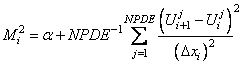
The value  determines the level of clustering or spatial smoothing of the
grid points. Decreasing from its default values also decreases the amount of spatial
smoothing. The parameters
determines the level of clustering or spatial smoothing of the
grid points. Decreasing from its default values also decreases the amount of spatial
smoothing. The parameters  approximate arc length and help determine the shape of the grid
or
approximate arc length and help determine the shape of the grid
or  distribution.
The parameterprevents
the grid movement from adjusting immediately to new values of the , thereby avoiding oscillations in
the grid that cause large relative errors in the solution. This is
important when applied to solutions with steep gradients.
distribution.
The parameterprevents
the grid movement from adjusting immediately to new values of the , thereby avoiding oscillations in
the grid that cause large relative errors in the solution. This is
important when applied to solutions with steep gradients.
The discrete form of the differential equation and the smoothing equations are combined to yield the implicit system of differential equations
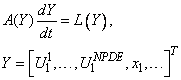
This is usually a stiff differential-algebraic system. It is solved using the integrator imsl_f_dea_petzold_gear, documented in this chapter. If imsl_f_dea_petzold_gear is needed during the evaluations of the differential equations or boundary conditions, it must be done in a separate thread to avoid possible problems with imsl_f_pde_1d_mg’s internal use of imsl_f_dea_petzold_gear. The only options for imsl_f_dea_petzold_gear set by imsl_f_pde_1d_mg are the Maximum BDF Order, and the absolute and relative error values, documented as IMSL_MAX_BDF_ORDER, and IMSL_ATOL_RTOL_SCALARS.
|
Visual Numerics, Inc. PHONE: 713.784.3131 FAX:713.781.9260 |