.p>.CMCH3.DOC!SPLINE_INTERP;spline_interp
Compute a spline interpolant.
Synopsis
#include <imsl.h>
Imsl_f_spline *imsl_f_spline_interp (int ndata, float xdata[], float fdata[], ¼, 0)
The type Imsl_d_spline function is imsl_d_spline_interp.
Required Arguments
int ndata
(Input)
Number of data points.
float xdata[]
(Input)
Array with ndata components
containing the abscissas of the interpolation problem.
float fdata[]
(Input)
Array with ndata components
containing the ordinates of the interpolation problem.
Return Value
A pointer to the structure that represents the spline interpolant. If an interpolant cannot be computed, then NULL is returned. To release this space, use free.
Synopsis with Optional Arguments
#include <imsl.h>
Imsl_f_spline
*imsl_f_spline_interp (int
ndata,
float
xdata[],
float fdata[],
IMSL_ORDER, int
order,
IMSL_KNOTS, float
knots[],
0)
Optional Arguments
IMSL_ORDER, int order
(Input)
The order of the spline subspace for which the knots are desired.
This option is used to communicate the order of the spline subspace.
Default:
order = 4,
i.e., cubic splines
IMSL_KNOTS, float knots[]
(Input)
This option requires the user to provide the knots.
Default:
knots are selected by the function imsl_f_spline_knots
using its defaults.
Description
Given the data points x = xdata, f = fdata, and the number n = ndata of elements in xdata and fdata, the default action of imsl_f_spline_interp computes a cubic (k = 4) spline interpolant s to the data using the default knot sequence generated by imsl_f_spline_knots.
The optional argument IMSL_ORDER allows the user to choose the order of the spline interpolant. The optional argument IMSL_KNOTS allows user specification of knots.
The function imsl_f_spline_interp is based on the routine SPLINT by de Boor (1978, p. 204).
First, imsl_f_spline_interp sorts the xdata vector and stores the result in x. The elements of the fdata vector are permuted appropriately and stored in f, yielding the equivalent data (xi, fi) for i = 0 to n − 1.
The following preliminary checks are performed on the data. We verify that
xi < xi+1 i = 0, …, n - 2
ti < ti+k i = 0, …., n - 1
ti < ti+1 i = 0, …, n + k - 2
The first test checks to see that the abscissas are distinct. The second and third inequalities verify that a valid knot sequence has been specified.
• In
order for the interpolation matrix to be nonsingular, we also check
tk-1 ≤ xi ≤ tn for
i = 0 to n − 1. This first
inequality in the last check is necessary since the method used to generate the
entries of the interpolation matrix requires that the k possibly nonzero
B-splines at xi,
Bj-i+1k+1, …, Bj where j satisfies tj £ xi < tj+1
be well-defined (that is, j − k + 1 ³ 0).
General conditions are not known for the exact behavior of the error in spline interpolation; however, if t and x are selected properly and the data points arise from the values of a smooth (say Ck) function f, i.e. fj = f(xj), then the error will behave in a predictable fashion. The maximum absolute error satisfies

where

For more information on this problem, see de Boor (1978, Chapter 13) and his reference. This function can be used in place of the IMSL function imsl_f_cub_spline_interp.
The return value for this function is a pointer of type Imsl_f_spline. The calling program must receive this in a pointer Imsl_f_spline *sp. This structure contains all the information to determine the spline (stored as a linear combination of B-splines) that is computed by this function. For example, the following code sequence evaluates this spline at x and returns the value in y.
y = imsl_f_spline_value (x, sp, 0)
Three spline interpolants of order 2, 3, and 5 are plotted. These splines use the default knots.
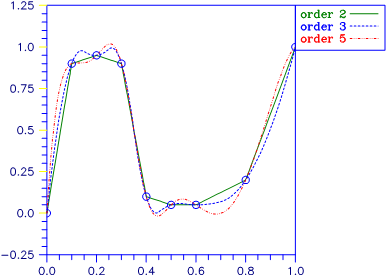
Figure 3- 3 Three Spline Interpolants
Examples
Example 1
In this example, a cubic spline interpolant to a function f is computed. The values of this spline are then compared with the exact function values. Since the default settings are used, the interpolant is determined by the “not-a-knot” condition (see de Boor 1978).
#include <imsl.h>
#include
<stdio.h>
#include <math.h>
#define NDATA
11
/* Define function */
#define F(x)
(float)(sin(15.0*x))
main()
{
int
i;
float
xdata[NDATA], fdata[NDATA], x, y;
Imsl_f_spline
*sp;
/* Set up a grid */
for (i = 0; i < NDATA;
i++) {
xdata[i] = (float)i
/((float)(NDATA-1));
fdata[i] =
F(xdata[i]);
}
/* Compute cubic spline interpolant */
sp =
imsl_f_spline_interp (NDATA, xdata, fdata,
0);
/* Print results */
printf("
x
F(x) Interpolant
Error\n");
for (i = 0; i < 2*NDATA-1;
i++){
x = (float) i
/(float)(2*NDATA-2);
y =
imsl_f_spline_value(x, sp, 0);
printf(" %6.3f %10.3f %10.3f %10.4f\n", x,
F(x),
y,
fabs(F(x)-y));
}
}
Output
x F(x)
Interpolant
Error
0.000
0.000
0.000
0.0000
0.050
0.682
0.809
0.1270
0.100
0.997
0.997
0.0000
0.150
0.778
0.723
0.0552
0.200
0.141
0.141
0.0000
0.250
-0.572
-0.549
0.0228
0.300
-0.978
-0.978
0.0000
0.350
-0.859
-0.843
0.0162
0.400
-0.279
-0.279
0.0000
0.450 0.450
0.441
0.0093
0.500
0.938
0.938
0.0000
0.550
0.923
0.903
0.0199
0.600
0.412
0.412
0.0000
0.650
-0.320
-0.315
0.0049
0.700
-0.880
-0.880
0.0000
0.750
-0.968
-0.938
0.0295
0.800
-0.537
-0.537
0.0000
0.850
0.183
0.148
0.0347
0.900
0.804
0.804
0.0000
0.950
0.994
1.086
0.0926
1.000
0.650
0.650 0.0000
Example 2
Recall that in the first example, a cubic spline interpolant to a function f is computed. The values of this spline are then compared with the exact function values. This example chooses to use a quadratic (k = 3) and a quintic k = 6 spline interpolant to the data instead of the default values.
#include <imsl.h>
#include
<stdio.h>
#include <math.h>
#define NDATA
11
/* Define function */
#define F(x)
(float)(sin(15.0*x))
main()
{
int
i, order;
float
fdata[NDATA], xdata[NDATA], x, y;
Imsl_f_spline
*sp;
/* Set up a grid */
for (i = 0; i < NDATA;
i++) {
xdata[i] = (float)i
/((float)(NDATA-1));
fdata[i] =
F(xdata[i]);
}
for (order =3;
order<7; order += 3)
{
/* Compute cubic spline interpolant
*/
sp = imsl_f_spline_interp
(NDATA, xdata, fdata,
IMSL_ORDER,
order,
0);
/* Print results */
printf("\nThe
order of the spline is %d\n",
order);
printf("
x
F(x) Interpolant
Error\n");
for (i =
NDATA/2; i < 3*NDATA/2;
i++){
x =
(float) i
/(float)(2*NDATA-2);
y =
imsl_f_spline_value(x,sp,0);
printf(" %6.3f %10.3f %10.3f %10.4f\n", x,
F(x),
y,
fabs(F(x)-y));
}
}
}
Output
The order of the spline is 3
x
F(x) Interpolant
Error
0.250
-0.572
-0.542 0.0299
0.300 -0.978
-0.978 0.0000
0.350 -0.859
-0.819 0.0397
0.400 -0.279
-0.279 0.0000
0.450
0.450
0.429 0.0210
0.500
0.938
0.938 0.0000
0.550
0.923
0.879 0.0433
0.600
0.412
0.412 0.0000
0.650 -0.320
-0.305 0.0149
0.700 -0.880
-0.880
0.0000
0.750
-0.968
-0.922 0.0459
The order of the spline is 6
x
F(x) Interpolant
Error
0.250
-0.572
-0.573 0.0016
0.300 -0.978
-0.978 0.0000
0.350 -0.859
-0.856 0.0031
0.400 -0.279
-0.279 0.0000
0.450
0.450
0.448 0.0020
0.500
0.938
0.938 0.0000
0.550
0.923
0.922 0.0003
0.600
0.412 0.412
0.0000
0.650 -0.320
-0.322 0.0025
0.700 -0.880
-0.880 0.0000
0.750 -0.968
-0.959 0.0090
Warning Errors
IMSL_ILL_COND_INTERP_PROB The interpolation matrix is ill-conditioned. The solution might not be accurate.
Fatal Errors
IMSL_DUPLICATE_XDATA_VALUES The xdata values must be distinct.
IMSL_KNOT_MULTIPLICITY Multiplicity of the knots cannot exceed the order of the spline.
IMSL_KNOT_NOT_INCREASING The knots must be nondecreasing.
IMSL_KNOT_XDATA_INTERLACING The i-th smallest element of xdata (xj) must satisfy tj ≤ xj < tj+order where t is the knot sequence.
IMSL_XDATA_TOO_LARGE The array xdata must satisfy xdataj ≤ tndata, for i = 1, ¼, ndata.
IMSL_XDATA_TOO_SMALL The array xdata must satisfy xdatai ³ torder-1, for i = 1, ¼, ndata.
|
Visual Numerics, Inc. PHONE: 713.784.3131 FAX:713.781.9260 |